

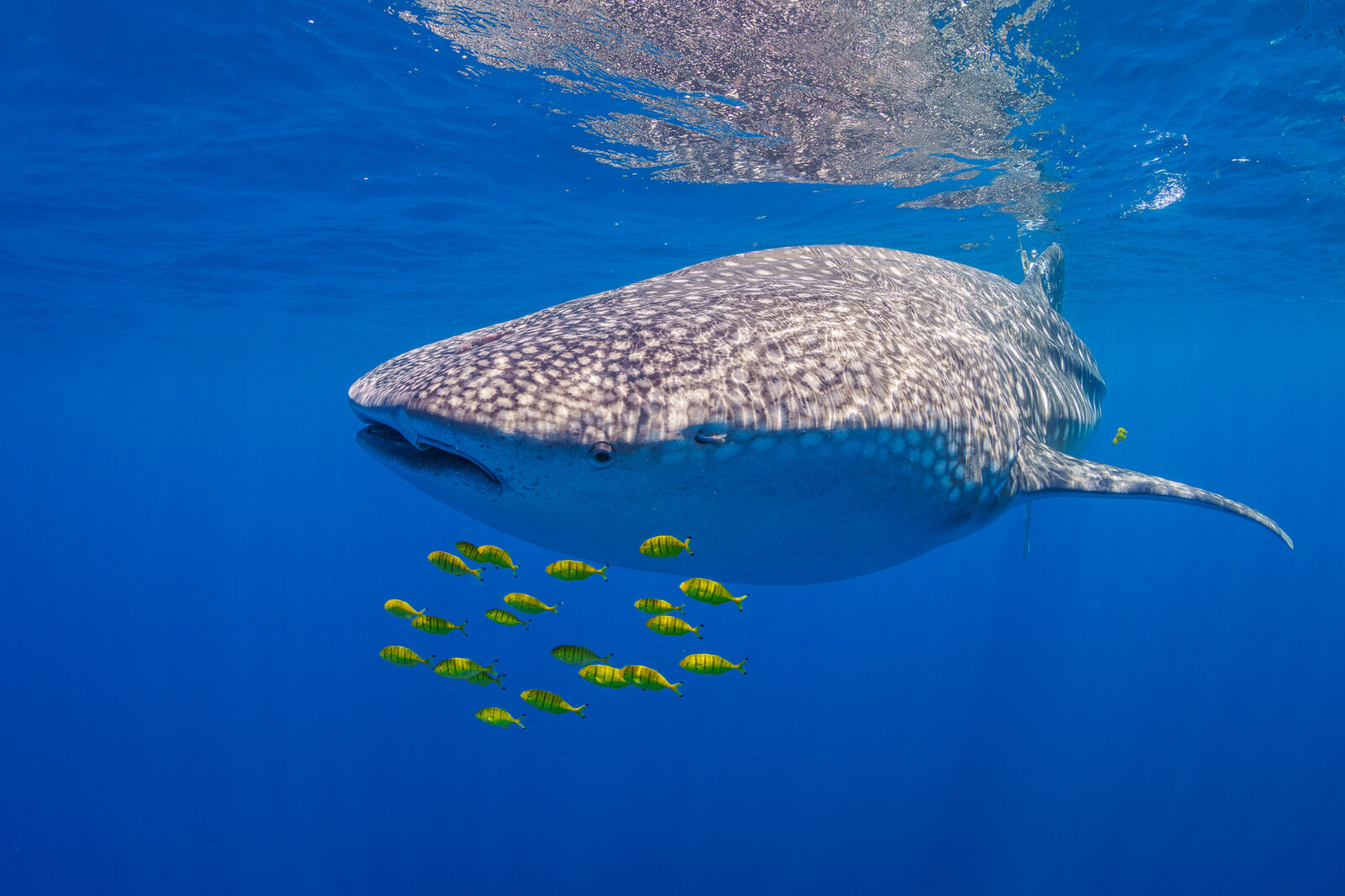
A whale shark swimming just below the surface, its spotted head and wide mouth facing the camera.

Adopt a Whale Shark

The world's biggest fish is Endangered. MMF leads or contributes to whale shark research from Mozambique to Oman.

Adopt a whale shark · $39Personalized certificate · Instant download

Your whale shark adoption

Adopt a whale shark for the ocean lover in your life. Your $39 symbolic adoption comes with a personalized certificate and supports MMF's work, including our Global Whale Shark Program and its research and conservation work on the world's biggest fish.

  • 18.8 mlargest widely accepted whale shark length estimate
  • Endangeredon the IUCN Red List, and still declining
  • 17,000+whale sharks identified by their spot patterns
  • 1,978 m+deepest published whale shark dive, possibly 2,527 m (8,290 ft)

What you'll give

The name stays in your browser and is not stored by MMF. You can change it after checkout.

Plus a gift card with your own message:

  • Birthday gift cardBirthday
  • Valentine's Day gift cardValentine's Day
  • Christmas gift cardChristmas
Dr. Simon Pierce

Signed by the scientist

“Our work has led to whale sharks, and their habitats, receiving protection in multiple countries.”

Dr. Simon PierceCo-Founder & Executive Director, Marine Megafauna Foundation

Why adopt a whale shark?

Whale sharks are the biggest fish in the world, and they are harmless to people. These filter feeders eat some of the ocean's smallest animals, and their tiny teeth play no part in feeding. When you adopt a whale shark, you back the people working to keep them in the sea.

They need that help. The current IUCN Red List assessment, led by MMF scientists, keeps whale sharks Endangered and still declining. It infers that numbers have fallen by 50 to 79% over the past three generations, about 120 years. Decades of targeted fishing did most of the damage.

Today the biggest problems are whale sharks caught accidentally in fishing nets and whale sharks killed by ships. A satellite-tracking study we contributed to found that 92% of the tracked sharks' horizontal space use overlapped with persistent traffic from large vessels. A dead whale shark typically sinks rather than washing ashore, so many of these deaths likely go unrecorded.
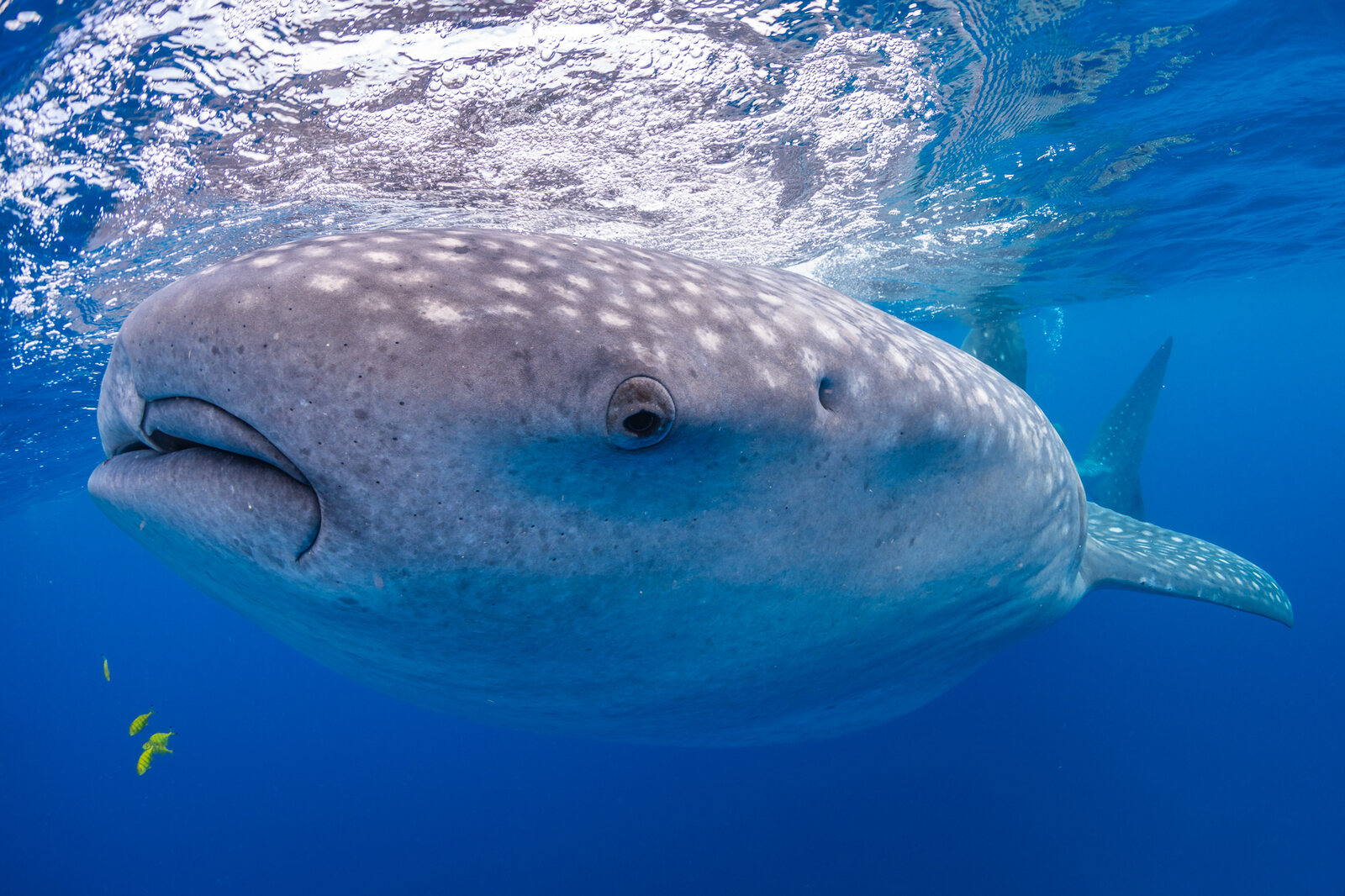
A whale shark seen face-on, its spotted head filling the frame, at Wreck Bay, Australia.

About whale sharks

The largest widely accepted length estimate for a whale shark is 18.8 meters (62 feet), and one reported catch weighed 34 metric tons (37 US tons). The second-largest fish, the basking shark, reaches about 12.3 meters (40 feet). Whale shark skin is up to 15 cm (6 inches) thick, the thickest in the animal kingdom.

For all that size, whale sharks feed on shrimp, fish eggs, krill, copepods, and crab larvae, plus small fish such as anchovies. Their prey must be small, because a whale shark's throat is only about the size of a baseball.

Whale sharks live in all tropical and warm temperate oceans, with their core range between about 30°N and 30°S. More than 50 coastal sites with predictable gatherings are now known, and young males of 4 to 8 meters (13 to 26 feet) dominate most of them. They also travel far: two sharks tagged off Madagascar by the Madagascar Whale Shark Project traveled at least 3,414 and 4,275 km (2,120 and 2,660 miles).

Each whale shark's spot pattern is unique and stable over decades, so a clear photo can identify the same shark year after year. Much of their life is still a mystery. Scientists have examined only one pregnant whale shark, which was carrying about 300 embryos.
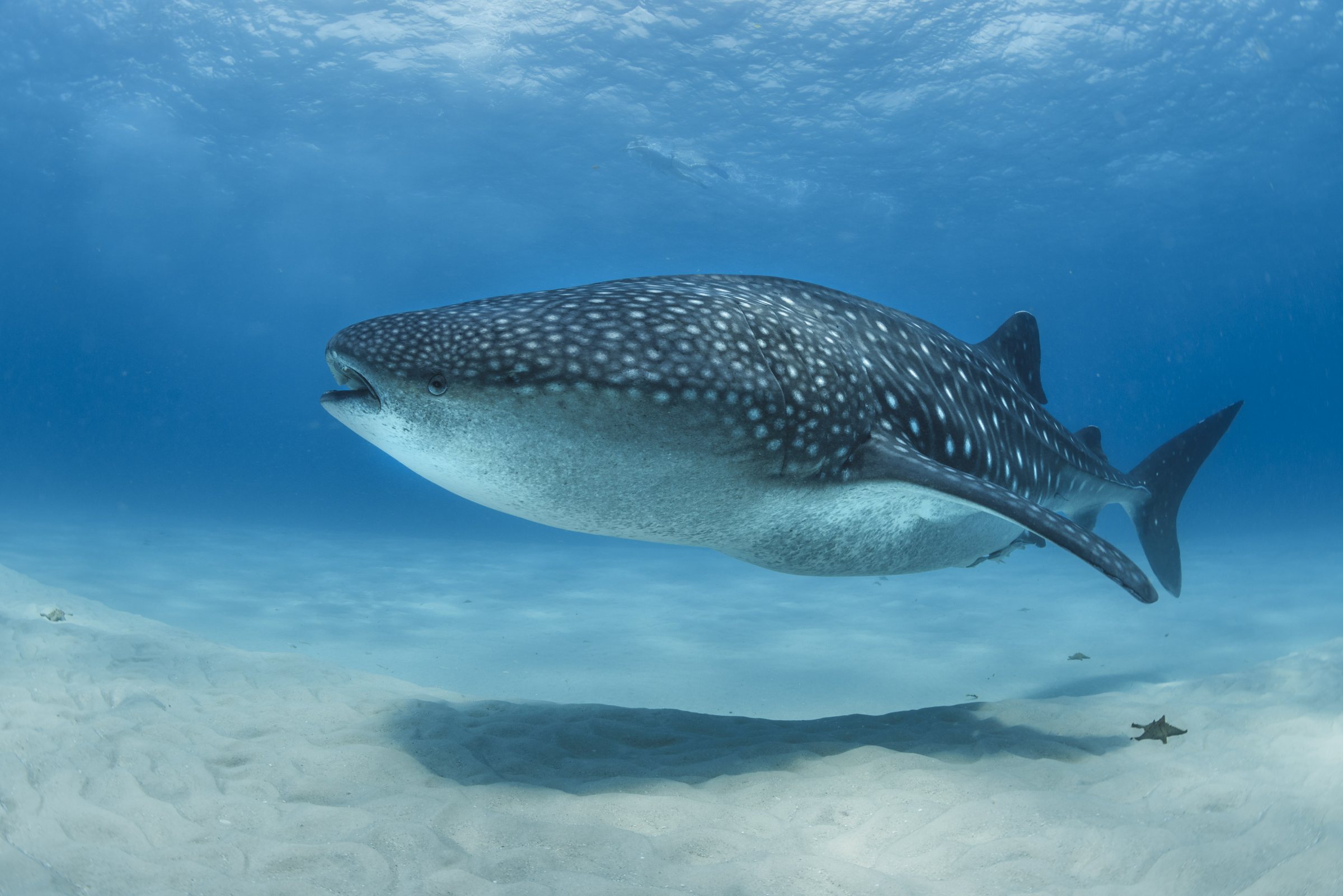
How your whale shark adoption helps

Your whale shark adoption supports MMF's work as a whole, including the Global Whale Shark Program, led by MMF's Dr. Simon Pierce, who co-edited the first scientific textbook on whale sharks and led the species' current Red List assessment.

Through the program, we lead or contribute to research at whale shark aggregation sites:

  • Mozambique: we have studied the sharks of southern Mozambique since 2005. Our 15-year survey off Praia do Tofo recorded an 87% drop in sightings, and our research and lobbying were a major factor in their legal protection in January 2021.
  • Tanzania: at Mafia Island we have monitored the same sharks since 2012 and identified 268 individuals, and monitoring from 2012 to 2019 found a stable population with high survival, a rare finding for this Endangered species.
  • Oman: our first dedicated field season, in June 2025, photo-identified 30 sharks and deployed nine satellite tags, the first ever placed on whale sharks in Omani waters.
  • Galápagos: the Galapagos Whale Shark Project leads the research at Darwin Island, one of the very few places where large females can be found predictably, with MMF as a collaborating partner. There, the team made the first ultrasound scans of wild whale sharks.
  • Madagascar: the Madagascar Whale Shark Project leads research at Nosy Be, with MMF collaborating. There, 546 sharks had been identified by the end of the 2025 season and the tourism code of conduct is now Malagasy law.

Ready to help? A whale shark adoption is $39, with a personalized certificate to download straight after checkout.

Adopt a whale shark · $39
How it works

  1. 1

    Adopt

    Pay securely in the pop-up. Your receipt arrives by email.

  2. 2

    Add the name

    Type the adoptee's name and see it on the certificate.

  3. 3

    Download and give

    Download the certificate and a gift card, then print or forward them.

Whale shark adoption FAQs

How big do whale sharks get?

The largest widely accepted length estimate is 18.8 meters (62 feet), and one reported catch weighed 34 metric tons (37 US tons). Most sharks seen at coastal feeding sites are young males of 4 to 8 meters (13 to 26 feet).

Are whale sharks dangerous?

No. Whale sharks are filter feeders with tiny teeth they don't use for feeding, and they pose no threat to swimmers or divers. The risk runs the other way: boat strikes and careless tourism injure sharks.

How deep can whale sharks dive?

At least 1,978 meters (6,490 feet), and possibly as deep as 2,527 meters (8,290 feet), the deepest whale shark dive published so far. A young male called Francky made the dive in October 2025, carrying a deep-rated tag fitted at Wreck Bay, Australia, the site of the Coral Sea project led by the Biopixel Oceans Foundation with our support.

How long do whale sharks live?

Nobody knows for sure. Published estimates run from about 80 to 130 years, and the oldest whale shark with a validated age is a 10-meter (33-foot) female confirmed at 50 years.

What is a symbolic adoption?

A symbolic adoption is a gift to MMF's work as a whole. We use it where it does the most good, and that includes the research and conservation behind the animal you chose. No animal is taken from the wild or sent to you. Your certificate records your support.

What do I receive?

A personalized adoption certificate (PDF) with the name you choose and the date, ready to download as soon as checkout is complete. You can also make a gift card for a birthday, Valentine's Day, or Christmas with your own message. Both are yours to print or send by email.

Can I give an adoption as a gift?

Yes. Type the recipient's name for the certificate and write your message on the gift card. Because everything is digital, it works as a last-minute gift too.

How do I get my certificate?

After checkout you are taken to a page where you type the name and download the certificate. The link to that page is also in your receipt email, so you can come back to it later.

Is my adoption tax-deductible?

Your adoption is tax-deductible in the USA. MMF is a registered 501(c)(3) non-profit conservation organization, and you receive a receipt by email.

Is anything sent by mail?

No. The certificate and card are digital files, so nothing is printed or shipped.

Adopt a Whale Shark · $39

Secure checkout by Donorbox. As soon as your adoption is complete you can make your certificate and gift card.

Form not loading? Open the secure checkout in a new tab.