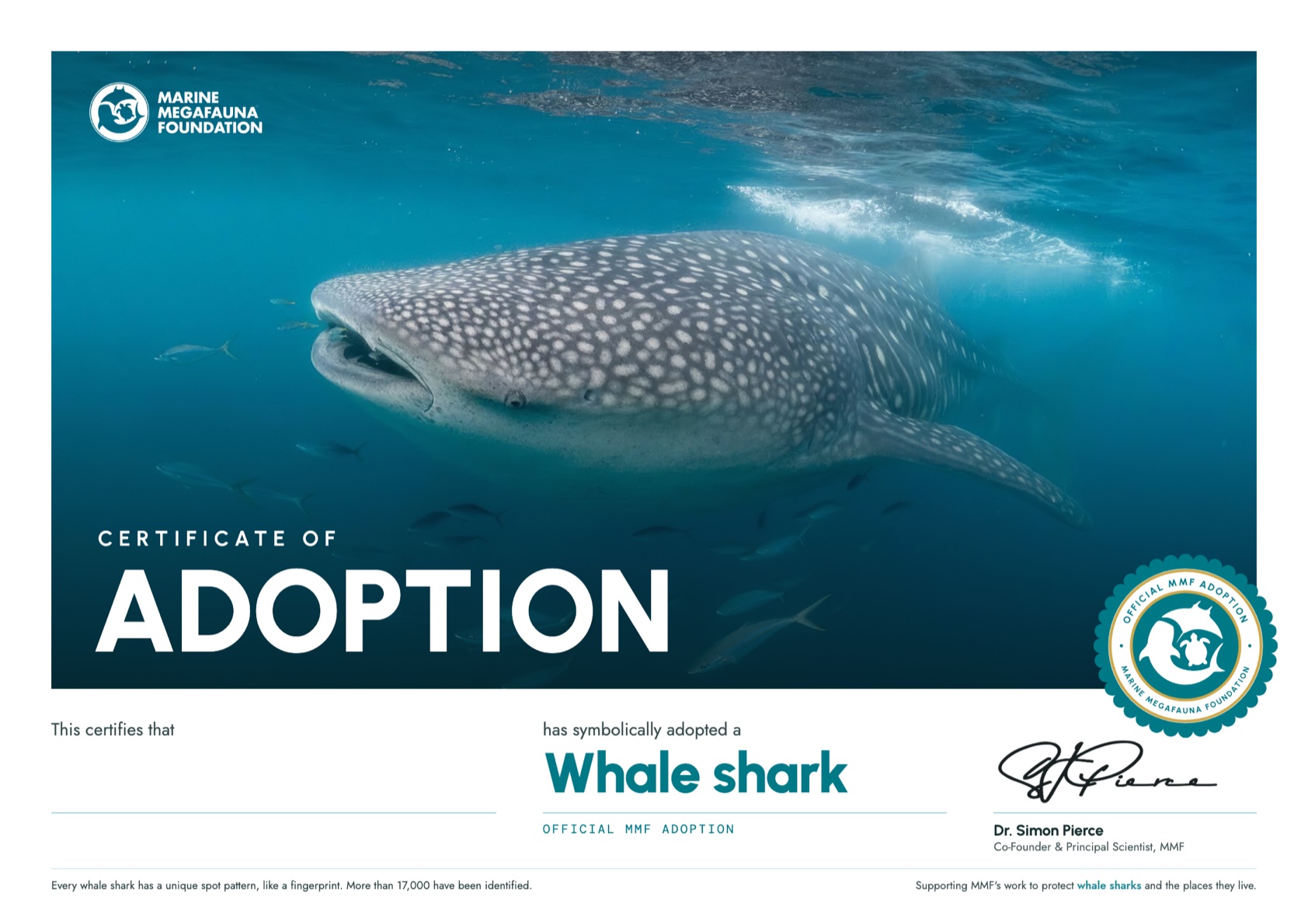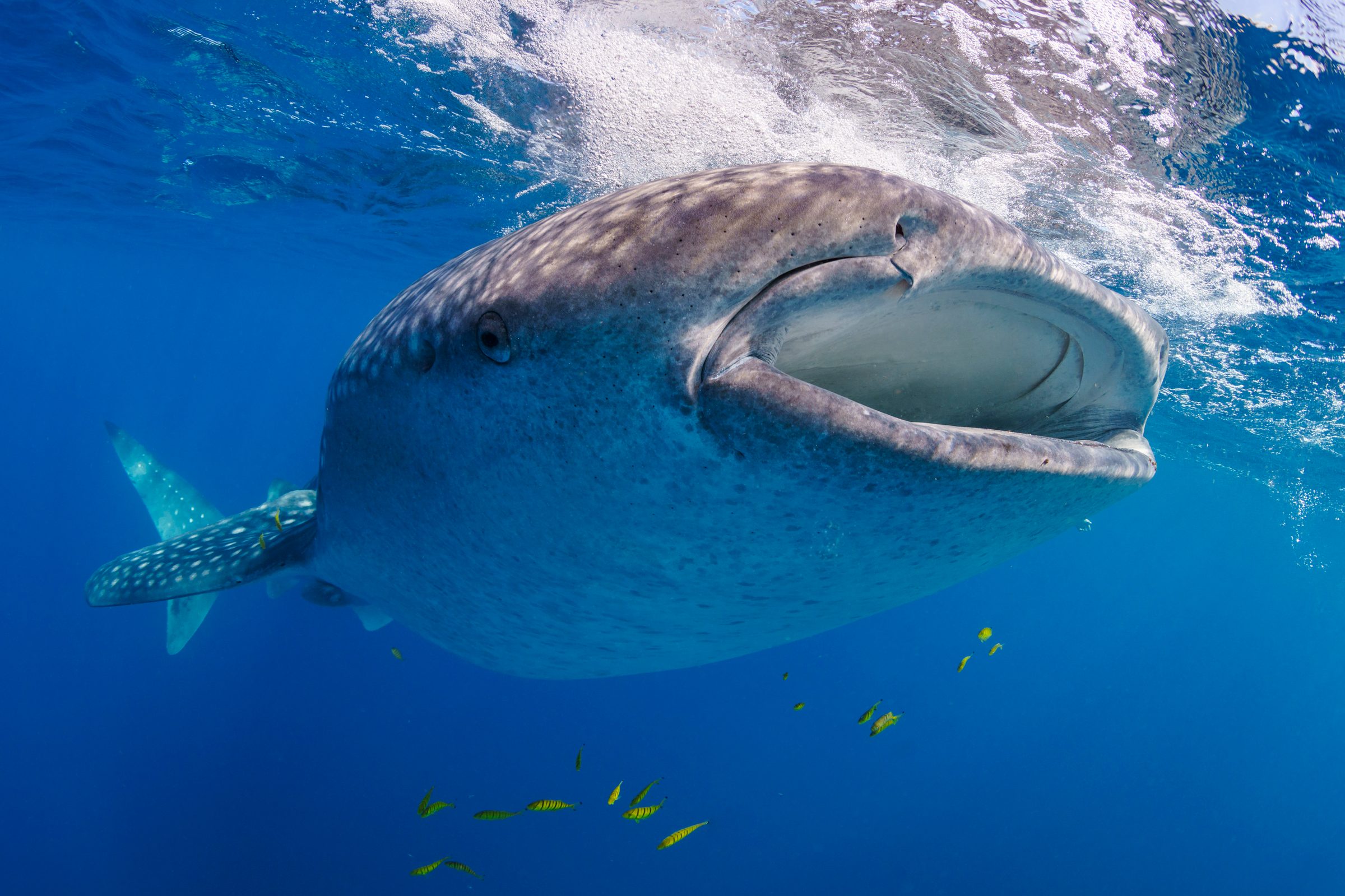





A whale shark just under the surface, its wide mouth open, with small yellow fish below it.

Rhincodon typus

Whale shark

Whale sharks · OverviewContents

The biggest fish in the ocean, and one of the least known: a spotted filter feeder that gathers at a handful of coastal sites, ranges across whole ocean basins, and is inferred to have lost 50 to 79% of its numbers over the past three generations.

The whale shark at a glance

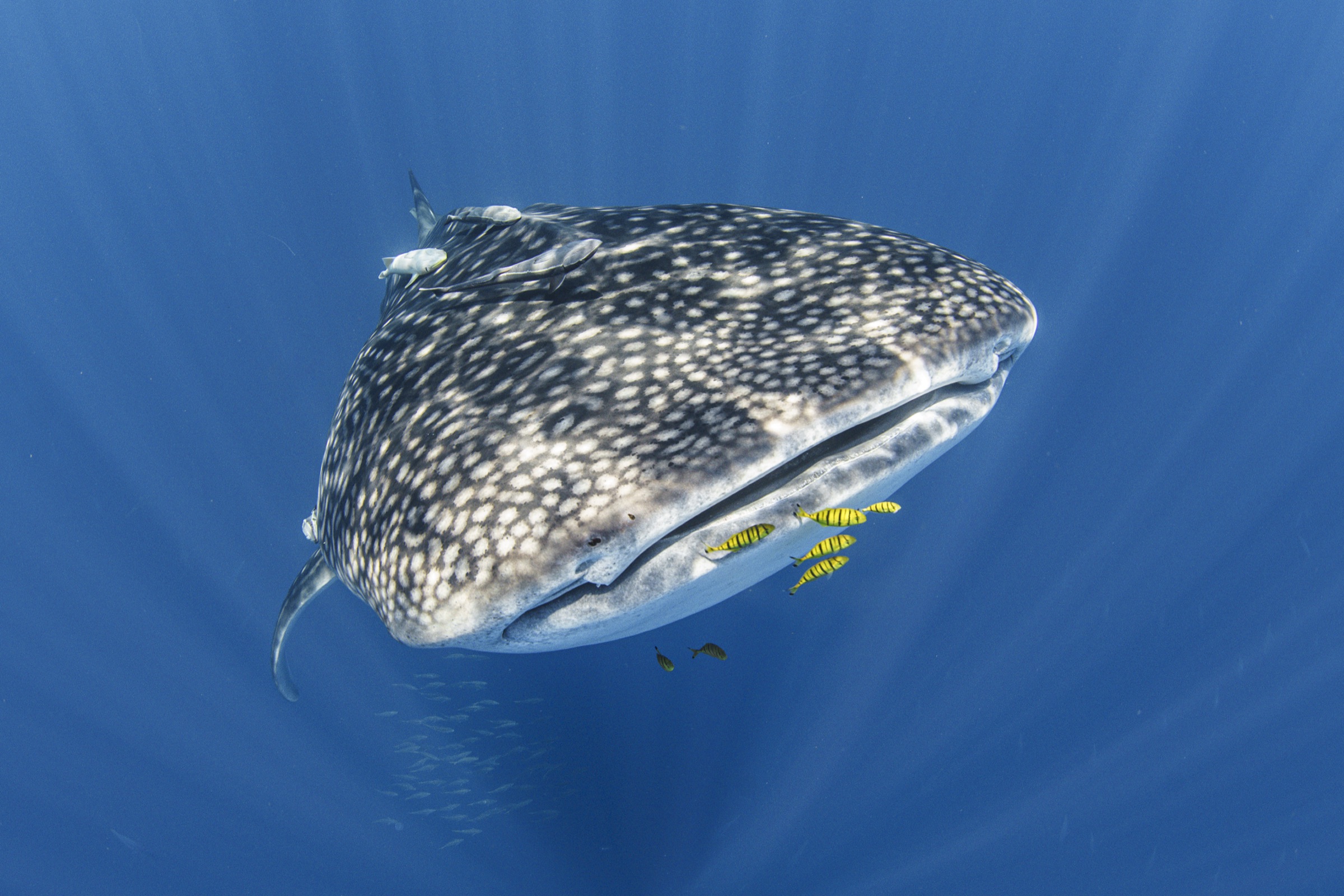
The largest fish in the ocean, and a contender for the largest fish that has ever lived. Each whale shark has a unique spot pattern, so photographs identify individuals and let us monitor populations over time.

Size
Up to 18.8 m (62 ft)The largest widely accepted length estimate
Diet
Plankton and small fishA filter feeder, with a throat about the size of a baseball
Range
Tropical and warm temperate seasMostly between about 30°N and 30°S
Deepest dive
At least 1,978 m (6,490 ft)Coral Sea, reported in 2026
Identified individuals
More than 17,000Global photo-identification database on Sharkbook.ai
Status
EndangeredIUCN Red List; inferred decline of 50 to 79% over three generations

From our facts page, the guide and the IUCN Red List assessment.

Our whale shark research

Our research began in southern Mozambique in 2005. Photo-identification, matching individuals by their spots, is its backbone: we contribute images from our surveys, dive operators, and visiting divers to Sharkbook.ai, Wild Me's shark photo-identification platform.

Around that catalog we measure size by laser photogrammetry (photographs with a laser scale), follow movements and diving with satellite tags, and record residency with arrays of underwater acoustic receivers. Tissue samples support genetic work and stable isotope analysis (a chemical record of diet), and underwater ultrasound lets us study reproduction. The results feed into global assessments, including the IUCN Red List.

15 whale shark projects in our directory, 7 of them completed studies. 53 whale shark publications by our team.

Where we study them

Choose a site to see what we study there and one thing we found. The map shows MMF's study sites, not the whale shark's whole range.

Study site Completed study

Study sites

  1. Darwin Island, Galápagos

    Galapagos Whale Shark Project

    Almost all the whale sharks passing Darwin Island are large adult females, a demographic rarely seen anywhere else.

    What we found

    We co-authored a study, led by Okinawa Churaumi Aquarium with the Galapagos Whale Shark Project, that used waterproofed ultrasound and drew blood from free-swimming whale sharks, both firsts for the species. Two females of 11 to 12 meters (36 to 39 feet) carried developing follicles (structures containing immature eggs), but no embryos or egg cases were found. Read the study

    About the project

  2. Utila, Honduras

    Utila Whale Shark Project

    Completed study

    Twelve years of sightings identified 95 whale sharks at Utila, and later regional work showed that these sharks move between Honduras, Belize, Mexico, and the United States.

    What we found

    Whale sharks have been reported at Utila in every month of the year: 95 individuals were identified there between 1999 and 2011, usually feeding at surface boils dominated by blackfin tuna. Read the study

    About the project

  3. Tofo, Mozambique

    Mozambique Whale Shark Project

    Since 2005

    Southern Mozambique is one of the world's most important whale shark feeding areas, and we have studied the sharks here since 2005 to understand and protect them.

    What we found

    Our 15-year series of 706 photo-identified sharks off Praia do Tofo, from 2005 to 2019, documented an 87% decline in sightings and an 89% fall in estimated abundance; the abundance of sharks 7 meters (23 feet) or longer fell by 99%. Read the study

    About the project

  4. Mafia Island, Tanzania

    Tanzania Whale Shark Project

    Since 2012

    The whale sharks off Mafia Island return to the same small stretch of coast year after year, and we have monitored them since 2012 to understand and protect them.

    What we found

    Acoustic tags on 51 sharks showed that many sharks stay when surface sightings stop between March and September, moving deeper and farther offshore. Across the year, their core habitat covered about 13 square kilometers (5 square miles). Read the study

    About the project

  5. Nosy Be, Madagascar

    Madagascar Whale Shark Project

    Since 2016

    Young whale sharks aggregate off Nosy Be from about September to December, and the Madagascar Whale Shark Project has studied and protected them since 2016.

    What we found

    Two sharks tagged off Madagascar by the Madagascar Whale Shark Project covered at least 3,414 and 4,275 kilometers (2,121 and 2,656 miles). Read the study

    About the project

  6. Al Shaheen, Qatar

    Qatar Whale Shark Project

    Completed study

    Every summer, more than a hundred whale sharks at a time aggregate in an offshore oil field in Qatar to feed on the eggs of spawning tuna.

    What we found

    Whale sharks aggregate in the Al Shaheen oil field off Qatar to feed on the eggs of mackerel tuna. Read the study

    About the project

  7. Muscat, Oman

    Oman Whale Shark Project

    Since 2024

    Mapping the Gulf of Oman's whale shark aggregation, documenting the injuries its sharks suffer from vessel strikes and fishing gear, and building the Omani partnerships that can protect them.

    What we found

    Our first dedicated field season in Omani waters, from Muscat in June 2025, photo-identified 30 whale sharks and deployed nine satellite tags, the first placed on whale sharks in Omani waters.

    About the project

  8. Bohol Sea, Philippines

    Philippines Whale Shark Project

    Completed study

    Satellite tags on 17 young whale sharks showed that they stayed in Philippine waters throughout tracking, yet spent most of their time offshore, over deep water.

    What we found

    All 17 juveniles tagged in LAMAVE's study, which we co-authored, stayed in Philippine waters, yet spent nearly three-quarters of their time offshore, over water deeper than 200 meters (660 feet). Read the study

    About the project

  9. Wreck Bay, Australia

    Coral Sea Whale Shark Project

    Completed study

    Young whale sharks aggregate at Wreck Bay each November and December before dispersing across the Coral Sea and beyond.

    What we found

    A deep-rated tag on a 7-meter (23-foot) juvenile male recorded a dive of at least 1,978 meters (6,490 feet), and possibly as deep as 2,527 meters (8,291 feet), the deepest yet recorded for a whale shark. The 2026 study was led by Dr. Ingo Miller of our Coral Sea partners and co-authored by MMF. Read the study

    About the project

Endangered, and protected under international law

The whale shark is Endangered on the IUCN Red List. The 2025 assessment, led by Dr Simon Pierce, infers that numbers have fallen by 50 to 79% over the past three generations, about 120 years, driven mainly by fisheries.

Targeted fisheries did most of the historic damage, and bycatch in net fisheries remains a threat. Ships are the threat that took longest to recognize: an international study we co-authored found that 92% of the horizontal space used by tracked whale sharks overlaps with persistent large-vessel traffic.

Whale sharks have been listed on Appendix I of the Convention on Migratory Species since 2017. Since 5 March 2026 they have also been on Appendix I of CITES, the international wildlife trade convention, which bans commercial international trade in the species. Legal protection is only the start: bycatch, vessel strikes, and habitat change still kill whale sharks.

India granted whale sharks its highest legal protection in 2001, yet 79 were still landed between 2001 and 2011 as bycatch, and a survey in China documented 186 sharks caught and traded. They are also landed irregularly in Indonesian artisanal fisheries and encircled in tuna purse-seine nets, where tagging shows they can survive release if handled well.

Why whale sharks are endangered

As seen in

Our whale shark research in the news

Logos of BBC, National Geographic, Forbes, The Guardian and The New York Times

How you can help

Symbolic adoption

Adopt a whale shark

The world's biggest fish is Endangered. MMF leads or contributes to whale shark research from Mozambique to Oman.

  • Certificate signed by Dr. Simon Pierce
  • Birthday, Valentine's or Christmas card
  • Instant download after checkout

Adopt a whale shark · $39

Also from our whale shark scientists: their whale shark publications.

From our whale shark facts page, guide, and species profile. The publication count includes reports, Red List assessments, and the whale shark book as well as papers.

MMF expeditions

Travel with our scientists

Every MMF expedition is hosted by a working marine scientist, who shares the latest research and conservation discoveries about the animals you'll see.

Our work is made possible by MMF’s core supporters

Join them as a core supporter